|
GCSE level biology exam revision notes on basic genetics
Genetics:
3.4 Explaining the inherited genetic disorder of sickle cell
anaemia disease
& possible genetic
outcomes explained with diagrams and Punnett squares
[Author
©
Dr Phil GRIC, Brown PhD:
Doc Brown's biology exam revision notes suitable for students of UK
IGCSE & GCSE level biology courses & ~ US grades 9-10 biology
[genome-3 updated
RE-EDIT]
[Key
points and learning objectives for this page, after the main body of
notes]
Index of biology notes on aspects of basic genetics (and links to other
genetics notes)
[email doc
b: comment? query?]
*
[privacy & cookies policies & disclaimer] * ]SEARCH]
(3.4)
Sickle cell diseases
- the most common is sickle cell anaemia (anemia)
Know and understand that some disorders like sickle
cell anemia are
inherited.
You need to be able to evaluate the outcomes
of pedigree analysis when screening for genetic disorders e.g. sickle cell
anaemia.
The genetically inherited disorder called sickle cell
anemia is
described and genetically explained below, and there are serious medical consequences.
Genomics and
sickle cell anaemia inherited disease
It is now known most of our characteristics
are controlled by more than one gene and this is also true for the genetically inherited
disease sickle cell anaemia.
Single-gene disorders like sickle cell
anaemia comply with what is called 'Mendelian inheritance'
and genetic diagrams and Punnett squares are quite easy to work out
- as I hope you will see below.
(Most diseases with a 'genetic connection' like
diabetes, obesity and cardiovascular diseases (heart disease)
involve the interaction of many genes including non-coding sections
of the genome's DNA and environmental factors e.g. lifestyle choice
- diet and exercise.)
Sickle cell anaemia is a genetic (inherited) blood
disorder in which red blood cells (the carriers of oxygen around the body),
develop abnormally.
A mutated change in the DNA base sequence of the gene for
haemoglobin (has a protein structure) results in abnormal haemoglobin
and sickle-shaped red blood cells
Instead of being round and flexible, the sickle red
blood cells become shaped like a crescent (hence the name 'sickle').
These
abnormal red blood cells can then clog sections of blood vessels (especially
the narrow capillaries) leading to pain. These painful effects can last from
a few minutes to several months.
The abnormal blood cells have a shorter
life-span and are not replaced as quickly as normal healthy red blood cells
leading to a shortage of red blood cells, called anaemia.
Symptoms of sickle
cell anaemia include tiredness, painful joints and muscles and
breathlessness, especially after exercise i.e. any extra physical exertion.
The highest frequency of sickle cell disease
is found in tropical regions, particularly sub-Sahara Africa, and
tribal regions of India and the Middle East.
Although less frequent, sickle cell disease
can occur in any population containing people whose ancestors came
from the geographical regions mentioned above - it is on the
increase in Europe due to current large scale migration from these
regions.
The connection between sickle cell anaemia and malaria
Malaria is a disease caused by a parasite called Plasmodium which
live inside Anopheles mosquitos. When an infected mosquito bites
you, parasites are transferred to you, multiply, and make you sick.
People who are heterozygous (HbSHbA)
for the sickle cell allele have some resistance to malaria.
In my genetic diagrams below, heterozygous is denoted as the
Aa
alleles.
Heterozygous people do not show any symptoms but are carriers
of the recessive allele.
Carriers, but not sufferers, of the sickle cell anaemia trait (SCT)
have some protection against malaria.
During malarial infection, people with SCT have 50-90% less
parasites in their blood and get rid of the parasites faster
compared to people with normal haemoglobin, so quicker to recover
and less likely to die.
The places where malaria is most common are also the places that
have the highest percentage of people with SCT. This is not by
accident.
Malaria is so deadly that the body came up with a way to
fight it via a mutation.
By changing the genetic code of haemoglobin and causing SCT,
the carrier has a better chance of surviving a disease with a
high death rate, but sickle cell anaemia is still a serious
condition.
The occurrence of sickle cell anaemia - a faulty
allele
For sickle cell anaemia to occur in a child,
both parents must carry the recessive allele
a for sickle cell disease, but
neither is affected by it, but occurrence of the double recessive gene will
cause the disease in the offspring.
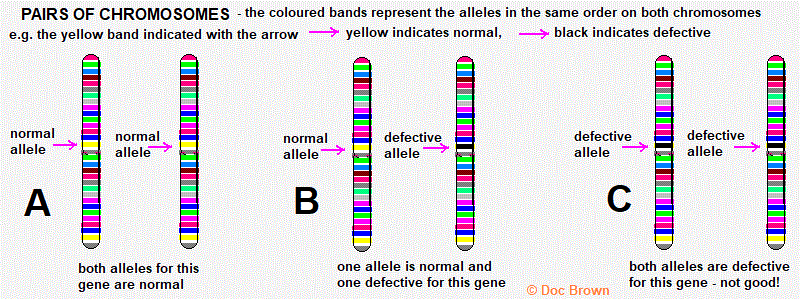
In the above diagram, imagine the
'arrowed' yellow band represents
one of the alleles that codes for red blood cells.
A
represents the normal dominant alleles in the pair of chromosomes
(notated as AA below in the genetic analysis).
This person is not a carrier or
sufferer of sickle cell anaemia.
B
represents a dominant normal and a defective recessive allele (notated
as Aa below in the genetic analysis).
This person is a carrier, but not
a sufferer of sickle cell anaemia because normal is dominant.
C
represents a person with a pair of defective recessive alleles (notated
as aa below in the genetic analysis).
This person is both a carrier and
sufferer of sickle cell anaemia - the double recessive gene prohibits
the production of the vital protein.
Genetic diagram and Punnett
squares for sickle cell anaemia to show how it is inherited

Genetic diagram normal, but carrier of sickle
cell anaemia, breeding with another normal, but carrier of the
faulty gene
However, there is a 1 in 4 (25%) chance that one of their
children will be affected by this genetic disorder - refer to diagram above
and Punnett table below, which shows a double recessive allele is needed for the
offspring to be affected (genotype aa).
Note
(i) For someone to suffer from sickle cell
anaemia, they must inherit the faulty allele (a) from both
parents.
(ii) There is a 3 in 4 chance (75%) of
offspring being carriers of
the recessive allele a, but only 1 in 3 (25%) of these will actually
suffer
from sickle cell anaemia.
|
Punnett square genetic table for sickle cell
anaemia |
|
Genotypes of parents: Aa x Aa
normal but both carriers |
|
Gametes:
A, a, A and a (alleles) |
|
Genotypes
of children - gametes - alleles |
A |
a |
|
A |
AA |
Aa |
|
a |
Aa |
aa |
AA = homozygous
alleles (dominant)
Aa =
heterozygous alleles
aa = homozygous
alleles (recessive)
Five other possible parental crosses
involving the recessive allele a for sickle cell anaemia.
I've shown below the analyses for
sickle cell anaemia using a basic Punnett square of the two pairs of
gametes of the parents and the four possible genotypes of offspring
(children).
|
2. genotypes of parents: Aa x aa |
Comments on cross 2.
for
sickle cell
anaemia
A carrier crossed with someone suffering from
sickle cell anaemia.
All the offspring will be carriers of the
recessive gene a.
2 in 4 chance (50%) of the offspring being
affected by sickle cell anaemia. |
|
genotypes
of children - gametes - alleles |
A |
a |
|
a |
Aa |
aa |
|
a |
Aa |
aa |
|
3. genotypes of parents: AA x Aa |
Comments on cross 3
for sickle cell anaemia
A non-carrier crossed with a carrier of sickle
cell anaemia recessive gene a.
2 in 4 chance (50%) of the offspring will be
carriers of the recessive gene a.
Non of the offspring will be affected by
sickle cell anaemia. |
|
genotypes
of children |
A |
A |
|
A |
AA |
AA |
|
a |
Aa |
Aa |
|
4. genotypes of parents: AA x aa |
Comments on cross 4.
for sickle cell anaemia
A non-carrier crossed with someone suffering from
sickle cell anaemia.
All the offspring will be carriers of the
recessive gene a.
Non of the offspring will be affected by
sickle cell anaemia. |
|
genotypes
of children |
A |
A |
|
a |
Aa |
Aa |
|
a |
Aa |
Aa |
Extra note on
sickle cell anaemia:
(i) For 5. AA x AA, all offspring will be
AA non affected and non carriers, similarly, for 6. aa x aa, all offspring
will be aa affected and all carriers.
(ii) For couples who may carry the recessive gene,
certain crosses carry an increased risk that their child might suffer
from sickle cell anaemia.
Genetic screening for potentially harmful
alleles may inform potential parents of the risk, but this may in
itself lead to agonising decisions.
In many poorer countries genetic screening
is highly unlikely to be available.
For lots more examples of genetic analysis of
offspring see the
index with lots of diagrams and
explanations.
Key points
Source of information is based on textbooks & syllabus-specifications for students taking the AQA
GCSE, Edexcel GCSE and OCR
GCSE level biology examinations (~US grades 9-10).
Key
points about the genetics of sickle cell anaemia
Sickle Cell
Anaemia: Inherited Genetic Disorder and Genetic Outcomes
Sickle cell anaemia is
an inherited blood disorder caused by a genetic mutation affecting
haemoglobin.
It leads to misshapen
red blood cells that reduce oxygen transport.
Understanding its
inheritance is important for studying human genetics, disease
prevention, and treatment.
1.
What Is Sickle
Cell Anaemia?
Sickle cell anaemia is
caused by a mutation in the HBB gene, which encodes
haemoglobin, the protein in red blood cells responsible for carrying
oxygen.
The mutation results
in abnormal haemoglobin S, which causes red blood
cells to become stiff and sickle-shaped.
Effects of
Sickle-Shaped Cells:
-
Reduced oxygen
transport in the body.
-
Blockages in blood
vessels, causing pain and organ damage.
-
Increased risk of
infections and stroke.
-
Shorter lifespan for
affected red blood cells, leading to anaemia.
2.
Genetic
Inheritance of Sickle Cell Anaemia
Sickle cell anaemia
follows a recessive inheritance pattern, meaning
both parents must pass on the mutated allele for the disease to
develop.
Genetic Possibilities:
| Parent Genotypes |
Possible Offspring
Outcomes |
Probability |
| AA (Normal) × SS (Affected) |
All offspring carry one sickle
cell allele (AS) but are unaffected (carriers). |
100% Carrier (AS) |
| AS (Carrier) × AS (Carrier) |
25% Normal (AA), 50% Carrier
(AS), 25% Affected (SS) |
1 in 4 chance of sickle cell
disease |
| AS (Carrier) × SS (Affected) |
50% Carrier (AS), 50% Affected
(SS) |
1 in 2 chance of sickle cell
disease |
| SS (Affected) × SS (Affected) |
100% Affected (SS) |
All offspring will inherit the
disease |
Key Genetic
Principles:
-
Homozygous
recessive (SS): Leads
to full sickle cell disease.
-
Heterozygous
(AS): Carrier status;
usually does not show symptoms but can pass on the allele.
-
Homozygous
dominant (AA): No
sickle cell trait or disease.
3.
Importance in
Human Genetics
Understanding sickle
cell anaemia is crucial for:
-
Medical
Research & Treatment:
Studying gene therapy, bone marrow transplants, and pain management.
-
Evolutionary
Biology: The
sickle cell trait (AS) provides resistance to malaria,
making it more common in regions with high malaria prevalence.
-
Genetic
Screening & Counselling:
Helping families understand inheritance risks and reproductive
choices.
-
Personalized
Medicine: Tailoring
treatments based on genetic profiles for better patient outcomes.
Sickle cell anaemia
demonstrates how genetic inheritance affects human health and
evolution.
Summary of learning objectives and key words or phrases
Know how to explain the genetics cause of the serious
medical condition of sickle cell anaemia/anemia.
Know the genetics of the inherited genetic disorder of sickle cell
anemia, caused by a faulty gene allele, work out the possible genetic outcomes
using Punnett squares
and cross bred diagrams for sickle cell anaemia.
For sickle cell anaemia you need to be able to construct genetic diagrams of monohybrid
crosses and predict the outcomes of monohybrid crosses and be able to use
the terms homozygous (same alleles e.g. AA) genes or heterozygous (different
alleles e.g. Aa) and understand the resulting phenotype (gene expression - the
outcome!) and genotype (gene type) for sickle cell anaemia.
Know how do you draw monohybrid genetic diagrams for
sickle cell anemia.
Know how to
construct Punnett squares for monohybrid crosses for sickle cell anaemia.
Be able to predict and/or
explain the outcome of crosses between individuals for each possible
combination of dominant and recessive alleles of the same gene for the
genetic disorder sickle cell anaemia and explain the observed phenotypes
from the genotypes of carriers of the genetic disorder sickle cell
anaemia.
WHAT NEXT?
TOP OF PAGE
INDEX of ALL my GENETICS notes
INDEX
of biology notes on aspects of basic genetics
INDEX of all my BIOLOGY NOTES
Find your GCSE
science course for more help links to revision notes
BIG website, try using the [SEARCH
BOX], maybe quicker than the many indexes!
Basic Science Quizzes for
UK KS3 science students aged ~12-14, ~US grades 6-8
Biology * Chemistry
* Physics for UK
GCSE level students aged ~14-16, ~US grades 9-10
Advanced Level Chemistry
for pre-university age ~16-18 ~US grades 11-12, K12 Honors
Find your GCSE/IGCSE
science course for more help links to all science revision notes
email doc
brown - comments - query?
Explaining importance of explaining the
genetics of inheriting sickle cell anaemia
in GCSE level biology, What you need to know about explaining the
genetics of inheriting sickle cell anaemia for
GCSE level
biology,
Explaining use of explaining the genetics of inheriting sickle cell
anaemia knowledge in GCSE level biology, Examples of explaining the
genetics of inheriting sickle cell anaemia
explained when studying GCSE level biology, What is the significance of
explaining the genetics of inheriting sickle cell anaemia in GCSE level biology, describing
explaining theory of explaining the genetics of inheriting sickle cell
anaemia when studying GCSE level biology, exam revision
notes for explaining the genetics of inheriting sickle cell anaemia, online help for understanding
explaining the genetics of inheriting sickle cell anaemia in GCSE
biology, what do I need to learn about explaining the genetics of
inheriting sickle cell anaemia? what do I need to know about
explaining the genetics of inheriting sickle cell anaemia for GCSE biology exams, how to prepare for questions on
explaining the genetics of inheriting sickle cell anaemia in GCSE
biology examination? explaining the genetics of inheriting sickle cell
anaemia for
syllabus-specifications
for students taking the IGCSE/GCSE level biology examinations, summary
revision notes key points on explaining the genetics of inheriting
sickle cell anaemia for students studying AQA
igcse/gcse biology notes on explaining the genetics of inheriting sickle cell
anaemia, Edexcel gcse
biology notes on explaining the genetics of inheriting sickle cell
anaemia, OCR 21st century GCSE
biology notes on explaining the genetics of inheriting sickle cell
anaemia, OCR gateway
GCSE biology notes on explaining the genetics of inheriting sickle
cell anaemia, WJEC gcse biology notes on explaining the genetics of
inheriting sickle cell anaemia, CCEA
gcse biology notes on explaining the genetics of inheriting sickle cell
anaemia, CIE Cambridge igcse
biology, notes on
explaining the genetics of inheriting sickle cell anaemia useful for US grade 9-10 biology student courses
SITEMAP Website content © Dr
Phil Brown 2000+. All copyrights reserved on Doc Brown's biology revision notes, images,
quizzes, worksheets etc. Copying of website material is NOT
permitted. Exam revision summaries and references to science course specifications
are unofficial.
|
